

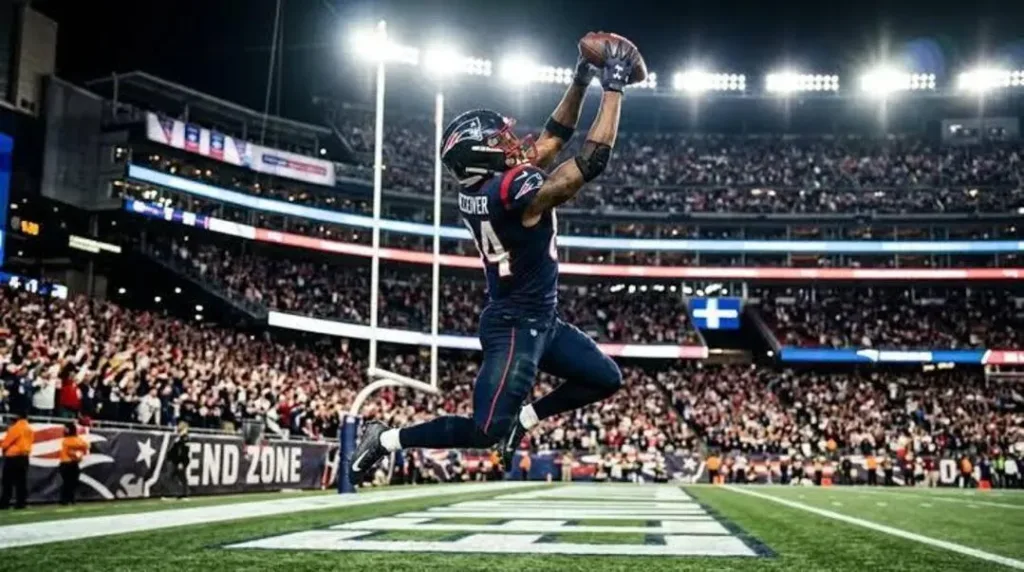
An NFL receiver catches a pass in the end zone for a successful two-point conversion. His team adds two points to the scoreboard, but the play does not increase his official receiving-yard total, regular reception count, or touchdown total. Depending on the sportsbook market, one wager involving that catch could win while another loses.
That is why NFL two-point conversion betting rules deserve more attention than the final score alone. Bettors comparing operator features through resources such as sportsbook reviews may learn about available markets and pricing, but a review rating does not establish how an individual player prop will settle. The actual market description and sportsbook house rules control the result.
The most surprising exception is that some specifically defined catch markets recognize a successful two-point conversion reception even though ordinary reception totals do not. This distinction, documented in FanDuel’s New York house rules, illustrates how two wagers on the same player and play can legitimately receive different grades.
Why an NFL Two-Point Conversion Is Not a Touchdown
A touchdown scores six points in the NFL. Once a team scores, it receives an additional opportunity called a try. The NFL’s official scoring rules distinguish six-point touchdowns from one- and two-point conversion attempts, explaining why a successful conversion adds to a team’s score without counting as another ordinary touchdown in player statistics.
The team can normally attempt a one-point kick or run an offensive play from the opponent’s two-yard line for a two-point conversion.
Both options occur after the touchdown, but they represent a separate scoring opportunity.
The NFL adopted the modern two-point conversion in 1994, adding a strategic alternative to the conventional extra-point kick. The rules were further reshaped in 2015, when the league moved the standard extra-point kick farther back while retaining the shorter distance for ordinary two-point attempts.
The distinction matters because a successful conversion can resemble a touchdown physically. A receiver might make a spectacular catch in the end zone, or a running back might cross the goal line with the football.
Yet the play is officially a two-point conversion, not another six-point touchdown.
The points are added to the team’s score, but the individual statistical record uses a separate category.
That difference determines how many common sportsbook markets are settled.
How Two-Point Conversions Affect Different NFL Bets
Consider a hypothetical scenario.
A receiver catches a touchdown pass and then catches another pass on the following two-point attempt.
The first catch produces a six-point touchdown.
The second produces two additional team points.
The receiver has scored one ordinary touchdown, not two, and the conversion catch does not add another regular reception or receiving yardage to the standard box score.
The effect depends on the accepted betting market.
| NFL betting market | Does the two-point conversion count? | What determines settlement |
|---|---|---|
| Full-game team total points | Yes | Official team score |
| Full-game over/under | Yes | Combined final points |
| Full-game point spread | Yes | Official winning margin |
| Anytime touchdown scorer | No | Official qualifying touchdowns |
| First touchdown scorer | No additional touchdown | The first actual touchdown of the game |
| Player receiving yards | No | Official receiving-yard statistics |
| Player receptions over/under | No | Official reception count |
| Quarterback passing touchdowns | No | Official passing-touchdown statistics |
| FanDuel New York’s Player to Catch Pass market | Yes, under the cited rule | The market expressly recognizes a conversion catch |
| Specific two-point conversion markets | Yes, subject to their terms | Successful conversion or other stated condition |
Comparison based on NFL scoring definitions and the reviewed sportsbook rules. Market availability and settlement conditions can differ by sportsbook, jurisdiction, and product.
The biggest lesson from this comparison is that a sportsbook can grade two selections differently without contradicting the NFL’s official records.
A team-score wager uses the points awarded to the team.
An ordinary player-statistics wager uses the statistical category specified in the market.
A specially worded proposition can use an entirely different eligibility condition.
Why a Two-Point Conversion Can Decide an Over/Under
The easiest financial consequence to understand involves a game-total wager.
Suppose a hypothetical game reaches the following score after a late touchdown but before the conversion attempt:
Team A 26 – Team B 17
The combined score is 43 points.
If Team A attempts and makes the extra-point kick, the score becomes 27–17, totaling 44 points.
If Team A instead completes a successful two-point conversion, the score becomes 28–17, totaling 45.
That one-point difference between the two successful try options can determine an entire game-total market.
Consider a bettor holding over 44.5 points.
With the successful one-point kick, the wager loses if there is no further scoring.
With the successful two-point conversion, the wager wins if there is no further scoring.
The Financial Difference at -110 Odds
Imagine a hypothetical $55 wager on over 44.5 total points at -110.
A winning ticket returns $105, comprising the $55 original stake and $50 profit.
If the final combined total is only 44, the bettor loses the $55 stake.
The difference between the two net outcomes is $105.
This does not mean a two-point conversion makes an over wager more attractive before the game. Coaches decide whether to attempt one or two points according to the circumstances, and neither type of try is guaranteed to succeed.
The example simply demonstrates that a successful conversion affects team-score markets even though it does not create another individual touchdown.
A Quarterback Can Throw Two Touchdowns and Lose an Anytime Touchdown Bet
Another frequent source of confusion is the difference between a passing touchdown and a touchdown scored personally.
Imagine a quarterback throws two conventional touchdown passes.
The receivers who catch those scoring passes are credited with receiving touchdowns.
The quarterback receives two passing touchdowns.
But the quarterback does not personally receive credit for scoring either touchdown.
For an ordinary anytime touchdown scorer wager, the player must be the qualifying scorer rather than merely the passer who delivered the football.
DraftKings and FanDuel both describe this distinction in their published touchdown-market guidance.
A quarterback who throws three touchdown passes but never carries or catches the football for a touchdown can therefore lose an anytime touchdown scorer wager.
The same quarterback can win an over 2.5 passing touchdowns prop.
Those outcomes are entirely consistent.
Quarterback Two-Point Passes Create Another Separation
Suppose the quarterback also completes a successful two-point conversion pass.
That play adds two points to the team’s score.
But it does not add a third or fourth passing touchdown to the quarterback’s official passing-touchdown total.
Neither does it satisfy the quarterback’s ordinary anytime touchdown scorer market.
The pass is recorded as participation in a successful conversion, a separate statistical event.
This makes the wording on the bet slip especially important. Player to score a touchdown, player passing touchdowns, and player to record a two-point conversion are different predictions.
The Special Catch Market That Creates an Exception
The most unusual settlement distinction involves a receiver who catches a successful two-point pass.
Ordinary reception and receiving-yard statistics exclude conversion-attempt production.
For example, imagine a receiver finishes a game with five standard receptions for 68 yards.
During the game, the receiver also catches a successful two-point pass.
The conventional box-score receiving total remains five catches for 68 yards.
A wager on over 5.5 receptions does not become a winner simply because the receiver made that conversion catch.
However, the applicable sportsbook rules can establish different treatment for a specially named market.
FanDuel’s New York football house rules, updated October 15, 2026, explicitly state that two-point conversion catches count as winning selections in its Player to Catch Pass market.
That creates an important distinction between a market asking whether a player catches a pass under its specific conditions and one requiring a particular official reception total.
Under those terms, a conversion catch can satisfy the specially defined catch market without increasing the player’s regular reception count.
It would be incorrect to assume every sportsbook recognizes this exception.
It would also be incorrect to treat all markets using the word catch as identical.
The precise market language determines what qualifies.
Defensive Two-Point Returns Also Have Separate Rules
Two-point conversion attempts can involve more than the original offense scoring.
If the defending team intercepts a pass or recovers a qualifying loose ball and returns it to the opposite end zone during the try, the defense can earn two points.
That possibility is established by the NFL’s scoring rules.
For example, imagine Team A attempts a two-point pass following a touchdown.
A defender from Team B intercepts the pass and returns it all the way to the opposite end zone.
Team B receives two points.
However, the play is not recorded as an ordinary six-point defensive touchdown.
A sportsbook market specifically concerning defensive two-point conversions may recognize that scoring event, while a standard defensive touchdown market generally does not treat it as a touchdown.
FanDuel’s reviewed New York rules also state that markets on two-point conversions include both offensive and defensive conversions unless a selection explicitly limits the outcome to one side.
This is why a market labeled successful two-point conversion should not automatically be interpreted as referring only to the offense that originally attempted the try.
Its conditions may include a defensive return.
The scoring team and the type of scoring event both matter.
First Touchdown Scorer Bets Ignore the Following Conversion
First touchdown scorer markets create another distinction worth understanding.
Consider a hypothetical game’s opening touchdown.
A running back scores from the three-yard line, giving the team six points.
The offense then completes a two-point conversion pass to its tight end.
The tight end has successfully contributed to the scoring sequence, but the running back remains the game’s first touchdown scorer.
The two-point catch has not created a second touchdown.
An ordinary first-touchdown scorer wager on the tight end does not win because of that conversion.
An anytime touchdown scorer wager on the tight end also remains unsuccessful unless the player later scores an actual qualifying touchdown.
A separate prop explicitly covering a successful two-point conversion could be settled differently.
This is particularly important when bettors follow a scoring drive through a live betting interface. A scoreboard update after the conversion is not evidence that another touchdown occurred.
Two-Point Conversions and Same-Game Parlays
The same distinction becomes relevant when multiple wagers are combined.
Consider a hypothetical same-game parlay containing:
- Over 44.5 total game points.
- A receiver to score an anytime touchdown.
- A quarterback to throw over 1.5 passing touchdowns.
A successful two-point conversion can affect the game-total selection.
It does not automatically satisfy the receiver’s anytime touchdown selection or add a passing touchdown to the quarterback’s statistics.
The parlay’s settlement therefore depends on the conditions of each individual leg.
A single scoring sequence can help one selection while doing nothing for another.
And even when a conversion is decisive for the game total, the overall parlay still requires every applicable selection to satisfy the sportsbook’s parlay conditions.
This is different from a bet being voided because of injury or nonparticipation.
An eligible player participating in a conversion does not automatically trigger a refund simply because the conversion is excluded from ordinary touchdown or yardage statistics.
The selection may simply lose when its required statistic is not recorded.
Why Sportsbook Rules Matter More Than the Broadcast Graphic
Television broadcasts often display a player’s involvement in a scoring play.
A quarterback may appear prominently after completing a two-point pass. A receiver may be shown celebrating a catch that produces two points.
Those images describe what happened on the field, but they do not necessarily describe the statistics that settle a betting market.
The relevant records should distinguish:
- Official touchdowns.
- Passing touchdowns.
- Receiving and rushing production.
- Successful offensive two-point conversions.
- Successful defensive two-point conversions.
- The final team score.
The NFL separates these categories for statistical purposes.
Sportsbooks then define which categories apply to each wagering product.
A bettor who sees a successful conversion catch may correctly remember the play while incorrectly assuming it increases the player’s ordinary receptions total.
That is a market-definition misunderstanding rather than necessarily a grading error.
It is also why comparing odds between sportsbooks requires more than checking the displayed payout.
Our existing guide to football spreads, totals, and player props explains the broader differences between these markets. Conversion-specific settlement rules add another consideration when evaluating which statistic a prop actually measures.
How to Review a Disputed NFL Prop Settlement
If a player appears to accomplish something on the field but the sportsbook grades the related wager as a loss, begin with the original bet slip.
Check the exact market title.
A bet on a player to catch at least one pass may have conditions different from a wager on over 0.5 official receptions.
Next, review the NFL’s official game record.
Identify whether the play was an ordinary touchdown, a standard reception, a successful two-point conversion, or a defensive conversion return.
Then locate the house rules governing the wager in the relevant jurisdiction.
If the rule is unclear, ask the sportsbook which statistical category controlled settlement and which market-specific provision applies.
Keep the original transaction details and any correspondence if the explanation remains disputed.
A useful complaint identifies a measurable difference between the accepted market conditions and the grading decision.
Simply pointing out that the player caught the ball or reached the end zone may not establish an error when the play occurred during a two-point try.
The Right Statistic Determines the Winning Ticket
A two-point conversion is valuable on the scoreboard, but it is not an ordinary touchdown.
That distinction affects moneylines, totals, spreads, touchdown props, receiving statistics, quarterback markets, and specially defined conversion wagers.
The unusual catch-market exception illustrates why the exact words on a sportsbook ticket matter. A play excluded from the standard reception count can still qualify for a different market that explicitly recognizes conversion catches.
For bettors, the practical lesson is to identify the relevant statistic before placing or disputing a wager.
A successful conversion adds two points to the team score. It does not automatically add a touchdown, pass completion, reception, or yardage to the player’s ordinary totals.
Understanding that distinction cannot predict the next scoring play, but it can prevent a misunderstanding about what a sportsbook has agreed to pay.