
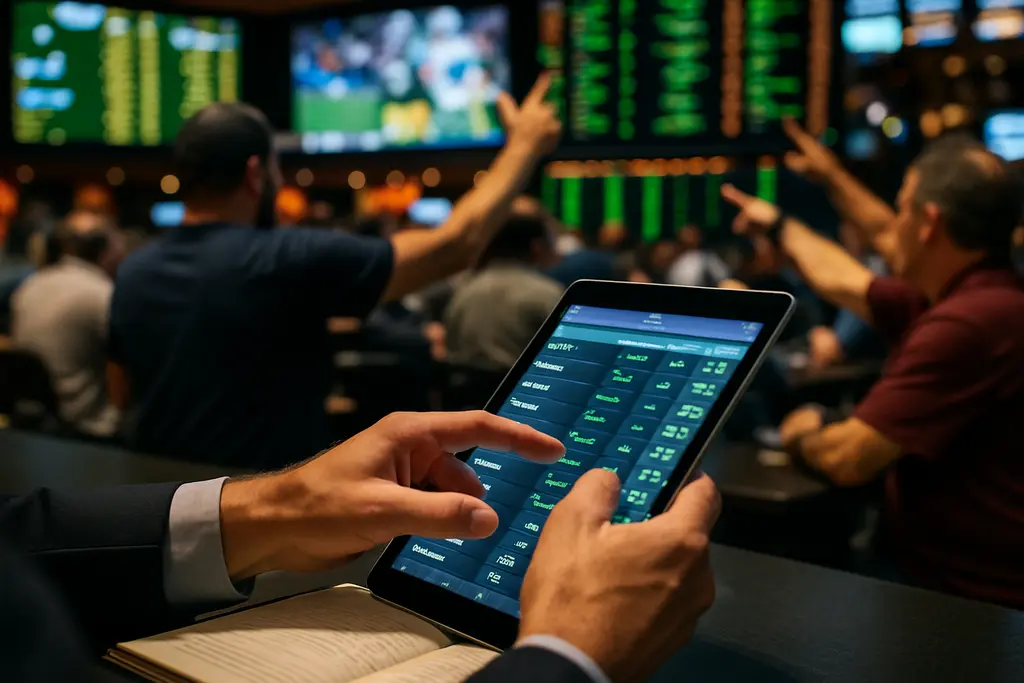
NFL betting markets now sit across two formats that can look similar on a phone screen but work from different assumptions. Traditional sportsbooks offer fixed-odds wagers, while prediction markets offer event contracts that users buy and sell. Neither format removes uncertainty, and neither should be treated as a shortcut to certain results. The useful question is narrower: how do price, access, product depth, and settlement rules change the way a person evaluates an NFL market?
The comparison matters because the NFL produces heavy event-driven demand: weekly games, prime-time matchups, futures, totals, and props. Sportsbooks built their products around that rhythm. Prediction markets have entered the same conversation by turning outcomes into contracts priced from $0 to $1. For a broader primer on the structural debate, this related article on prediction markets vs sportsbooks sets out why the issue has moved beyond a niche finance topic.
How NFL betting markets Set Prices
Fixed Odds Versus Event Contracts
A sportsbook price is posted by the operator. If a user accepts it, the payout terms are generally locked at the time of the wager, subject to the book’s house rules. The book builds margin into its numbers and manages risk through price changes, limits, bet acceptance rules, and other controls. A common example is a two-sided market priced at -110 on each side; that structure implies an overround of about 104.76% before any outcome is known.
A prediction market is framed differently. Users buy or sell “Yes” or “No” contracts on an outcome, with prices typically quoted between $0 and $1. A contract at 65 cents roughly signals a 65% market expectation before fees, spread, and liquidity are considered. That price can move as new information arrives, such as injuries, weather, lineup news, or public demand around a prime-time game.
Why NFL betting markets Feel Different
The counterparty question is central. At a sportsbook, the user is betting against the house. On an exchange-style prediction market, users are meant to trade against other participants. That distinction sounds clean, but the real market can be less tidy. A 2026 SEC comment file argued that sports prediction-market makers can serve a house-like role by providing liquidity, pricing contracts, and carrying exposure through settlement SEC comment file. That does not make every contract identical to a sportsbook wager, but it does warn readers not to judge the product only by its branding.
For NFL betting markets, the practical test is not whether one format sounds more modern. The test is whether the price is clear, the cost is visible, the rules are understandable, and the market has enough depth to enter or exit without paying too much through spread or fees.
| Feature | Traditional Sportsbook | Prediction Market |
|---|---|---|
| Price Format | Fixed odds such as moneyline, spread, totals, props | Yes/No contracts priced between $0 and $1 |
| Counterparty | The sportsbook acts as the house | Users trade against other market participants, with liquidity providers involved |
| Main Cost | Vig or margin inside the odds | Fees, spread, and execution price |
| Exit Before Final Result | Cash-out may be offered at operator discretion | Contracts can often be sold before resolution if liquidity exists |
| Product Breadth | Deep menus, live betting, props, parlays, same-game parlays | More focused on standard outcomes, totals, futures, and selected event contracts |
Regulation And Access In 2026
Federal Oversight Versus State Licensing
Regulation is one of the sharpest dividing lines. Sportsbooks are licensed state by state under gambling laws. That means access, product rules, tax treatment, consumer protections, and permitted bet types can vary by jurisdiction. Prediction markets have relied on federal commodities oversight, which is why some platforms have argued they can operate in places where state-licensed sports betting is not available.
As of mid-September 2026, the legal picture had not settled into a simple national rule. Research notes point to the Third Circuit siding with Kalshi in April 2026 on the treatment of sports contracts under federal commodities law, while a later Utah court ruling allowed state enforcement to proceed. Action Network’s NFL comparison described the split between exchange-style sports contracts and state-licensed sportsbook access, including the ability to sell a contract before resolution where liquidity exists Action Network analysis.
That uncertainty matters for readers because access is not the same as suitability. A market may be available in one location and restricted in another. Rules can change after court decisions, agency action, or platform policy updates. Anyone comparing products should read local rules, account terms, and settlement language rather than assuming an NFL market is treated the same everywhere.
Availability Is Not The Same As Protection
The research notes identify states such as California, Texas, Florida, and Georgia as examples where prediction-market access has been discussed in relation to places without broadly legal state sportsbook betting. That does not mean every user in those states has the same access, the same product menu, or the same protections. State gambling laws, federal oversight, and platform restrictions can all affect the user experience.
Sportsbooks, by contrast, operate only where they are licensed. That narrower access can be frustrating for users outside legal states, but licensing also brings defined state-level rules. Those rules may cover advertising, account controls, disputes, responsible-gaming tools, data standards, and integrity monitoring. The trade-off is not simply freedom versus restriction; it is also about which regulator is accountable for the market a user is entering.
Product Depth Around NFL Games
Where Sportsbooks Still Offer More Choice
Sportsbooks remain stronger on product variety around NFL games. They commonly offer spreads, moneylines, totals, player props, team props, futures, parlays, same-game parlays, and in-game markets. That range matters during a typical NFL week because interest does not sit only on the winner. Bettors may compare a passing-yard prop, a first-half total, an alternate spread, and a live price after a turnover.
Prediction markets are growing in sports, but the research notes describe a more limited product mix, often centered on standard outcomes, totals, futures, and selected contracts. That can make them cleaner for probability comparison but less complete for users who focus on prop variety or live betting. Market depth can also differ sharply by event. A nationally watched NFL game may attract more activity than a smaller market, but even then, the visible contract price is only part of the cost. Bid-ask spread, order size, and fees can change the final result for the user.
Technology also sits behind these differences. Sportsbooks need pricing engines, risk tools, account systems, and trading controls to run large NFL menus, while exchanges need order books, matching systems, and settlement rules. For readers studying the operator side rather than making picks, this sportsbook software resource provides context on the infrastructure that supports sportsbook products.
Live Betting And Exit Options
Live betting is one area where the user experience can split. Sportsbooks can suspend and reopen markets during plays, adjust prices after injuries or scoring drives, and offer cash-out where they choose. Cash-out is not a right; it is a price offered by the operator, and it may disappear during volatile periods.
Prediction markets may allow a contract holder to sell before the event resolves, but that exit depends on liquidity. If other users are not willing to trade at a fair price, the theoretical ability to exit may be expensive or limited. For NFL betting markets, that means a user should compare not just the headline probability but also the depth around the price. A thin order book can turn a good-looking number into a poor execution.
Risk Checks Before Comparing NFL Markets

Read The Rules Before The Price
The first risk check is settlement language. A sportsbook wager is governed by house rules, while a prediction-market contract is governed by its event terms and resolution source. A question that seems simple before kickoff can become disputed if a game is postponed, shortened, canceled, or affected by stat corrections. NFL markets tied to awards, season futures, or playoff qualification may also depend on exact wording.
The second risk check is cost. Sportsbook margin can be less visible because it is built into the odds. Prediction-market costs can appear through fees and spread. Neither structure is automatically cheaper. A user comparing prices should convert odds or contract prices into implied probability, then account for the actual cost of entering and exiting.
The third risk check is behavior. Fast-moving NFL news can tempt people into rushed decisions. Injury reports, inactive lists, weather updates, and coaching choices may move prices quickly, but a quick market move does not prove value. Analysis should start with the event, the rule set, and the price, not with the hope that one app has a simple answer.
- Check whether the market is licensed, federally overseen, or otherwise restricted in your location.
- Compare the total cost: vig, fees, spread, and any exit price.
- Read settlement rules before using futures, props, or unusual event contracts.
- Assume prices can move before kickoff and during live play.
- Use responsible limits and avoid treating any market as certain.
Careful Reading Of NFL Market Differences
A careful read of NFL betting markets shows that the sportsbook-versus-prediction-market debate is less about which side is “better” and more about fit. Sportsbooks are built for breadth, familiar bet types, live menus, and state-licensed consumer rules. Prediction markets are built around tradable event contracts, visible probabilities, and the ability to enter or exit positions where liquidity supports it.
The fair comparison is practical. What is the real price after cost? Who controls settlement? Can the user exit before the game ends, and at what spread? Is the market legal and accessible in the user’s location? Are there clear safeguards if something goes wrong?
No format makes NFL outcomes predictable. The stronger approach is to treat both products as markets with costs, rules, and risk. That keeps the focus where it belongs: not on promised wins, but on understanding how the market is built before any decision is made.
Leave a Reply