
Ever looked at a sports betting site and felt lost? You’re not alone! Starting out can feel like learning a whole new language.
That feeling of confusion ends right here. We’ve created this A-Z guide to make all that jargon clear and actionable. You can actually use it.
Think of it as your cheat sheet for soccer. We’ll cover everything from basic market types to the analytics terms pros use.
Our goal is simple: to give you the confidence to understand any wager slip or analysis. Let’s demystify the lingo together and make you a more informed fan!
Market Types (1X2, AH, Totals, BTTS, Props)
The betting slip can look confusing at first. But it’s just a menu of different market types. Let’s decode them together. Each market is a different question you can answer with a “yes” or “no” (and a wager!). Mastering these options is how you move from guessing to informed betting.
We’ll walk through the five most essential soccer betting markets. You’ll learn what each one means, when it’s most useful, and how to spot them instantly.
The 1X2 Bet (Win, Draw, Win)
This is the classic, straightforward market. You’re simply picking one of three outcomes for the match: a home win (1), a draw (X), or an away win (2). It’s also called a three-way moneyline.
Use a 1X2 bet when you have a strong feeling about who will win or if a draw seems likely. It’s perfect for evenly matched teams where the result is truly anyone’s guess.
Asian Handicap (AH) – Leveling the Field
What do you do when one team is a huge favorite? The Asian Handicap solves this by giving the underdog a virtual head start. It “handicaps” the favorite by subtracting goals from their final score before the bet is settled.
For example, a -1.5 AH on Team A means they must win by 2 or more goals for your bet to win. The beauty? It eliminates the draw possibility, creating a two-way (win/lose) market. This is your go-to tool for lopsided matches.
Totals (Over/Under)
Here, you’re betting on the total number of goals scored in the match, regardless of who wins. The sportsbook sets a line, like 2.5 goals. You then bet “Over” (more than 2.5 goals) or “Under” (fewer than 2.5 goals).
These are also called goal lines or Over/Under bets. They’re fantastic when you expect a defensive stalemate or a goal-fest. You can even find totals for just the first or second half!
Both Teams to Score (BTTS)
This market is incredibly popular for its simplicity and excitement. The question is simple: “Will both teams score at least one goal?” You just bet “Yes” or “No.”
A BTTS bet lets you focus purely on attacking play. It doesn’t matter if the game ends 1-1 or 4-3—as long as both teams score, a “Yes” bet wins. It’s ideal for rivalries or matches featuring attack-minded teams with weaker defenses.
Proposition Bets (Props)
Proposition bets, or “props,” let you wager on specific events within the match. These are the fun, micro-markets that go beyond the final score.
Common soccer props include:
- A specific player to score a goal
- Total number of corner kicks
- Which team will receive the first yellow card
- Whether a goal will be scored in the first 15 minutes
Props are perfect when you have deep knowledge about a player or a specific match dynamic. They add an extra layer of engagement to your viewing experience.
Quick Market Reference Guide
| Market | What You’re Betting On | Best For |
|---|---|---|
| 1X2 | The match outcome: Home Win, Draw, or Away Win. | Evenly contested matches with no clear favorite. |
| Asian Handicap (AH) | A team to win after a virtual goal handicap is applied. | Matches with a strong favorite to get better odds. |
| Totals (Over/Under) | The total number of goals scored being over or under a set line. | Predicting a high-scoring or low-scoring game style. |
| Both Teams to Score (BTTS) | Whether or not both teams will score at least one goal. | Games featuring two attacking teams likely to exchange goals. |
| Proposition Bets (Props) | A specific event or player performance within the match. | Using specialized knowledge for focused, fun bets. |
Now you can look at a list of markets and know exactly what each one asks of you. This knowledge is your foundation. Next, we’ll look at how these bets are priced—the math behind the odds.
Pricing & Math (Implied Probability, Overround, Margin)
Ever wondered how bookmakers set their prices? It’s all about mixing probability and margin. Don’t worry about the numbers! Odds are like a price tag for how likely something is, with a small fee for the bookie’s service. We’ll show you how to read different odds formats, calculate the real probability, and find the hidden margin. This knowledge is your financial literacy toolkit for betting!

The Three Faces of Odds: American, Decimal, and Fractional
Bookmakers show odds in different styles, based on where you are. In the US, you’ll mostly see American odds. Let’s break them down so you can read them easily.
American Odds use a plus (+) or minus (-) sign. A negative number (e.g., -150) means how much you need to bet to win $100. A positive number (e.g., +200) shows how much you’d win on a $100 bet.
Decimal Odds (like 1.91) are popular worldwide. They show your total return per $1 staked, including your original bet. Just multiply your stake by the decimal number.
Fractional Odds (like 4/1) are common in the UK. They show your profit relative to your stake. For 4/1, you profit $4 for every $1 you bet.
| Format | Example | How to Read It | Stake $10 Returns |
|---|---|---|---|
| American | -110 | Bet $110 to win $100 | $19.09 |
| Decimal | 1.91 | Total return per $1 staked | $19.10 |
| Fractional | 10/11 | Profit $10 for every $11 staked | $19.09 |
Implied Probability: The Truth Behind the Numbers
Odds aren’t just prices; they show a percentage chance. This is called implied probability. It’s the bookmaker’s guess of an outcome’s likelihood, hidden in the odds.
Here’s the simple formula for Decimal odds: Implied Probability = 1 / Decimal Odds.
So, decimal odds of 2.00 mean a 50% chance (1 / 2.00 = 0.50). Odds of 1.50 mean about a 66.7% chance (1 / 1.50 ≈ 0.667).
For American odds, the calculation is slightly different:
- For negative odds (-): Implied Probability = (Absolute value of Odds) / ((Absolute value of Odds) + 100). Example: -150 gives 150/(150+100) = 60%.
- For positive odds (+): Implied Probability = 100 / (Odds + 100). Example: +200 gives 100/(200+100) ≈ 33.3%.
Why does this matter? By converting odds to probability, you can spot if a bet offers value. If you think a team’s true chance of winning is 70%, but the odds imply only 60%, that’s a good value bet!
The Bookmaker’s Edge: Understanding Overround and Margin
Here’s the catch: if you add up the implied probabilities for all possible outcomes in a match, it will total more than 100%. This extra is the bookmaker’s “overround” or “margin.” It’s how they make sure to profit over time.
Let’s say a soccer match has these decimal odds: Home Win: 2.10 (47.6% implied), Draw: 3.25 (30.8%), Away Win: 3.80 (26.3%). Add them up: 47.6% + 30.8% + 26.3% = 104.7%. The overround is 4.7%.
This margin is their built-in profit. On average, for every $100 wagered on this market, the bookmaker expects to keep $4.70. Knowing this helps you see that odds are not pure probabilities—they’re probabilities plus a fee.
Double Chance Bets: A Safer Wager with Adjusted Odds
Now, let’s apply this math to a popular market: the double chance bet. This wager lets you cover two of the three possible outcomes (1X2). You can bet on “Home Win or Draw,” “Away Win or Draw,” or “Home Win or Away Win.”
It’s a safer option because you have two chances to win! But safety comes at a cost. The odds for a double chance bet are lower because the implied probability is higher.
How does it work? The bookmaker combines the probability of the two outcomes. For example, if Home Win has a 47.6% chance and Draw has a 30.8% chance, a “Home Win or Draw” double chance bet has a combined probability of 78.4%. The decimal odds would then be calculated as 1 / 0.784 ≈ 1.28.
See the trade-off? Your chance of winning jumps, but your payout shrinks. Using implied probability helps you understand exactly what you’re paying for that extra security.
Mastering these concepts—odds formats, implied probability, and margin—transforms you from a casual punter into an informed bettor. You’ll start seeing the market through the lens of value, not just luck!
Competition & Scheduling Terms (Fixtures, Quick Turnarounds)
Before you bet, think about when the game is played. Soccer isn’t just about the teams. It’s about the whole competition and calendar. This knowledge makes you a better bettor.
Knowing a team’s schedule helps you spot fatigue and predict lineup changes. It turns a simple guess into a smart decision.
Fixtures & The Calendar: Your Roadmap
The term fixture means a scheduled match. But the fixture list is the master schedule. It shows who plays whom and when.
Different competitions have different rhythms. The English Premier League (EPL) is a long marathon. Major League Soccer (MLS) has a unique schedule with playoffs.
Elite tournaments like the UEFA Champions League are intense. Teams face a double grind—tough league games followed by European matches. This is key for bettors.
Tournament Formats & Stages
Many big prizes are won in tournaments, not leagues. Knowing the format is essential.
Most tournaments start with a group stage. Teams play each other to earn points. The top teams advance to the knockout rounds.
Knockout football is win-or-go-home. It includes rounds like the Round of 16 and the Final. The pressure is high, and styles of play can become cautious. This is important for betting on markets like Over/Under goals.
The Grind: Quick Turnarounds & Congestion
This is where the physical demand hits. A quick turnaround means little rest between matches.
Think of it like a back-to-back in basketball. Player fatigue builds up, and recovery time shrinks. This often leads to unpredictable results.
A congested schedule is packed with games in a short time. It’s common during holidays in England or for teams competing on several fronts.
| Competition | Schedule Density | Key Scheduling Quirk |
|---|---|---|
| English Premier League | High | Famous holiday fixtures (Boxing Day, New Year’s) with quick turnarounds. |
| MLS | Medium-High | Season runs March-October, with playoffs creating a knockout tournament after. |
| UEFA Champions League | Variable | Group stage games are midweek, forcing league/cup adjustments for participants. |
| International Tournaments (World Cup) | Very High | Group stage games every 3-4 days, testing squad depth intensely. |
So, how does this help your betting? Knowing a top team’s tough schedule can affect their performance. They might be more likely to draw a match they’d normally win.
This is where a market like draw no bet becomes powerful. This bet removes the draw as a losing outcome. If your team wins, you win. If they lose, you lose. If it’s a draw, your stake is returned. It’s a smarter way to back a tired favorite.
We always say: look at the calendar first, then look at the odds. A team’s schedule tells a story about their energy and focus. Learning to read that story will make you a better soccer bettor.
Live Betting Lingo
Live betting turns watching soccer into an exciting game of strategy and timing. It’s also known as in-play betting. You place bets after the game starts. The odds change with every play, reflecting the game’s flow.
To do well, you need to understand the terms. Let’s explore the key words that help you make smart bets in real-time.
Reading the Match “State”
The “state” of a match shows its current pace and direction. Is one team controlling the game? Are there lots of attacks on goal? Has a key player been injured?
Knowing the state helps predict what’s next. For example, if a team is pushing hard but hasn’t scored, a goal might be near. This can make live betting markets like “Next Team to Score” more appealing.
Remember, odds change quickly when the game state shifts. A red card or an unexpected goal can change everything instantly!
When a Team “Parks the Bus”
This term means a team sets up in a very defensive formation. They use all ten outfield players to protect a lead or secure a draw. It’s hard for the opponent to score.
This affects your in-play betting strategy. When a team parks the bus, goals are less likely. You might see the live “Over/Under” total goals line drop.
Betting on “Under” the new total or on “No” for “Both Teams to Score” could be smart. The team with the ball might have lots of possession but few clear chances.
Understanding In-Play Suspensions
Sportsbooks aren’t always quick to adjust odds. Sometimes, major events happen too fast. That’s when an “in-play suspension” occurs.
The bookmaker temporarily pauses all betting on that specific market. This usually happens right after a game-changing moment, like a penalty being awarded, a red card shown, or a goal scored that is under video review.
Don’t worry if your bet slip freezes! The suspension lifts once new odds are set. It’s a safety feature to prevent bets on outdated, unfair prices.
| Live Scenario | Key Term | What Happens to Odds | Smart Betting Move |
|---|---|---|---|
| One team attacks constantly but can’t score. | Match State (Sustained Pressure) | Odds for that team to score next shorten. | Consider “Next Goal” market before they break through. |
| A team gets a red card while leading 1-0. | In-Play Suspension | All markets freeze, then odds for the short-handed team drift. | After the suspension, look for value on the opposing team or “Over” if they push for an equalizer. |
| A coach subs on an extra defender to protect a lead. | Park the Bus | Odds for “Under” on total goals drop sharply. | The “Both Teams to Score – No” option might offer good value. |
| A star forward is injured and subbed off. | Match State (Key Player Out) | Odds for that team to win get longer. | Assess if the odds overreact; the team’s strategy may change. |
Learning this live betting vocabulary helps you understand the game as it happens. You’ll spot patterns and opportunities that casual viewers miss. Keep an eye on the state, watch for defensive tactics, and don’t be surprised by suspensions—they’re all part of the thrilling world of in-play action!
Analytics Words (xG, xThreat, PPDA, field tilt)
To guess what will happen, you must look beyond what did happen. The final score is just history. Smart betting is about understanding the story the data tells.
Welcome to soccer analytics! These terms help you see which team truly controlled the game and created the best chances. Let’s translate them from stats jargon into your betting advantage.
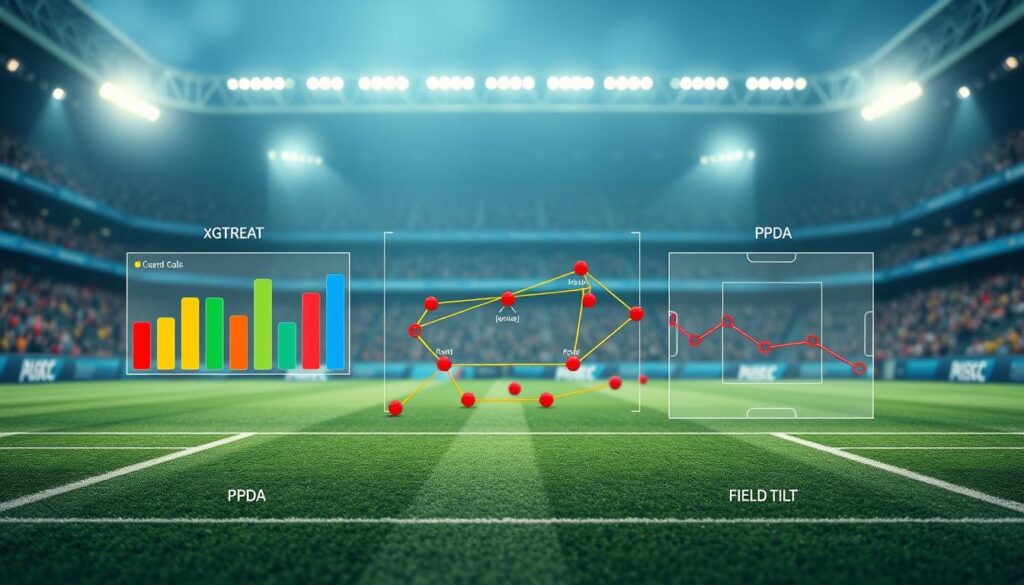
We’ll start with the rockstar of soccer data. It’s changed how fans, analysts, and bettors see the game.
Expected Goals (xG)
xG is like a shot’s “quality score.” It doesn’t care if the ball went in. It calculates the probability of a goal based on the shot’s location, body part used, and other factors.
A tap-in from two yards out might have an xG of 0.9. A long-range screamer might only be 0.05. By adding up a team’s xG, you see how many goals they should have scored.
Why does this matter for betting? A team that consistently scores less than their xG might be unlucky or have poor finishers. A team that concedes more goals than the xG they allow might have a shaky defense. Spotting these trends is powerful.
Expected Threat (xThreat)
If xG judges the shot, xThreat judges the pass that led to it. It measures how much a player’s action (usually a pass or carry) increases the chance of a goal in the next few moves.
A risky through-ball that splits the defense has high xThreat. A sideways pass in your own half has very low xThreat. This metric helps you identify players and teams that are genuinely creative, not just ones that pass a lot.
PPDA (Passes Per Defensive Action)
This one’s all about pressure. PPDA counts how many passes the opposing team makes before your team attempts a tackle, interception, or foul.
A low PPDA (like 8-10) means a team is pressing aggressively and high up the pitch. A high PPDA (like 18-20) means they sit back and let the opponent have the ball. Knowing a team’s typical PPDA helps you bet on how a match will flow—will it be a frantic press or a cautious battle?
Field Tilt
Field Tilt is a simple but revealing stat. It’s the share of possession a team has, but only in the final third of the pitch. Who is dominating the ball where it matters most?
A team can have 60% overall possession but only 40% Field Tilt. That means they’re passing around in their own half! High Field Tilt often correlates with sustained pressure and better scoring chances.
| Metric | What It Measures | Key Betting Insight |
|---|---|---|
| xG (Expected Goals) | Quality of scoring chances | Identifies teams over or under-performing their results. |
| xThreat (Expected Threat) | Danger created by passes/ carries | Spots truly creative players & teams beyond basic assists. |
| PPDA | Defensive pressing intensity | Predicts match tempo and where the ball will be fought over. |
| Field Tilt | Possession in the attacking third | Shows which team is applying real pressure near the goal. |
Using these analytics words turns you from a scoreboard watcher into a game analyst. You start to see the underlying performance that drives future results. That’s where the smart betting opportunities hide.
Promo/Book Terms: Understanding the Fine Print
Ever seen a ‘risk-free bet’ or ‘odds boost’ and wondered what the catch is? You’re not alone—the promotional language used by sportsbooks is its own dialect. Mastering this vocabulary is key. It turns confusing offers into tools you can use smartly to protect and grow your bankroll.
Let’s break down the most common promo and bookmaker terms. We’ll focus on the ones that directly impact your money and your freedom to use it.
Cash Out: Your Early Exit Strategy
Imagine you placed a bet, and the game is going your way—but there’s always time for a twist. The cash-out feature lets you settle the bet early. You can lock in a profit or cut a loss before the final whistle.
The offer is calculated in real-time based on the current state of the game. It’s a powerful tool for risk management. But, the cash-out value is always less than your full win. The sportsbook takes a small cut for providing this early exit.
Bonuses and Bonus Bets: The Free Play Fine Print
The word bonus is everywhere. It usually refers to extra betting credit or free bets offered as an incentive. A “Bonus Bet” is typically a token you can use to place a wager. If it wins, you keep the profit, but you usually don’t get the stake back.
Common bonus structures include:
- Bet & Get: Place a qualifying bet, receive a bonus.
- Bet Builder Bonus: Get enhanced odds or a bonus when you combine selections in a single bet.
- Deposit Match: The book matches your deposit with bonus funds.
Always read the specific rules. For a deeper dive into using these offers effectively, check out our guide on getting the most from sportsbook promotions.
Rollover (Wagering Requirements): The Playthrough Rule
This is the most critical term to understand. A rollover, often called “wagering requirements,” is the amount you must bet before you can withdraw bonus winnings.
For example, a “$50 bonus with a 5x rollover” means you must wager $250 total. Only bets that meet certain odds thresholds usually count. This rule protects the sportsbook from players who just withdraw the bonus cash.
Failing to complete the rollover means you forfeit the bonus and any winnings from it. Always check the terms before claiming any offer. Knowing the rollover helps you decide if a promotion is truly valuable for your style of play.
Understanding these promo terms puts you in control. You can confidently evaluate offers, use features like cash-out strategically, and ensure you meet all playthrough rules. This knowledge turns promotional hype into genuine betting advantage.
Quick Reference Tables + downloadable PDF
You now know a lot about soccer betting terms. We’ve put key terms into easy-to-use tables for you. Think of this as your quick guide for any game.
The tables are organized by category. Need to remember a market type like BTTS or a math term like implied probability? You can find it fast.
We also made a downloadable PDF glossary for you. You can save it on your phone or print it. For more sports betting terms, check out this sports betting glossary PDF.
Market Types
1X2, Asian Handicap (AH), Over/Under Totals, Both Teams to Score (BTTS), Proposition Bets.
Pricing & Math
Implied Probability, Overround, Vigorish, Margin, Value.
Competition Terms
Fixture, Derby, Quick Turnaround, Squad Rotation.
Live Betting Lingo
In-Play, Park the Bus, Momentum Shift, Cash Out.
Analytics Words
Expected Goals (xG), Passes Per Defensive Action (PPDA), Field Tilt.
Book & Promo Terms
Rollover, Bet Boost, Free Bet, Stake.
Keep this page saved. Use the PDF for studying offline. Now, you can watch games with a sharper, more informed view.
Leave a Reply