

The loudest opinion is rarely the smartest one. In sports, finance, or politics, consensus is a comforting blanket—but also a dangerous trap.
This leads us to a powerful concept: the contrarian betting strategy. It’s all about “fading the public.” You bet against the crowd’s emotional, story-driven choices.
Think back to 2008. While most people invested in mortgage-backed securities, a few skeptics noticed the problems. They didn’t bet against the crowd for fun. They made calculated moves.
That’s the real edge. It’s not about being a contrarian for the sake of it. It’s about using data to find value where others see only a story. We use predictable biases to our advantage.
The casual bettor loves a good story. The sharp bettor loves the numbers that stories hide. Let’s look at how to find the quiet dissent in the loud crowd.
Public vs sharp money: what split data can and can’t tell you
Ticket vs handle splits are like a popularity contest versus a silent auction in betting. The crowd’s roar is on one side, and the high roller’s nod is on the other. This drama is central, and the data is our script.
The “ticket count” shows what the crowd thinks. It’s driven by stars, viral moments, or pretty uniforms. It’s all about sentiment, not deep analysis.
The “handle” shows what the pros think. When a team gets 30% of bets but 60% of money, it’s a secret whisper. It’s the fade the public signal, where sharps speak with their wallets.
This data is a signal, not a story. It tells you that smart money is moving, but not why. It’s like seeing Warren Buffett buy a stock. You know it’s significant, but you need to understand the business.
Where you get this data is key. DraftKings data is like polling a crowded bar—it’s the public square. Circa data is like the backroom where real deals happen. The action is sharper, and the stakes are higher.
Split data can’t reveal overlapping interests. Maybe that “sharp” money is just one whale, not many pros. It also can’t account for timing. That big bet might have been placed days ago.
Using only this data is like driving with only the rearview mirror. You know where you’ve been, but not what’s coming. The true edge comes from combining this data with your own analysis.
Use splits as a filter, not a final answer. They show where sentiment and value are opposite. That’s where the real opportunity and need for sharp analysis start.
Spotting overreactions: media hype, rivalry weeks, marquee TV windows
Narrative bias affects more than just what we talk about. It also changes betting lines, giving smart bettors an edge. People don’t bet on stats like defense or offense. They bet on stories, and sports media is always spinning new ones.
When a consensus pick emerges, it’s a big deal. It starts with a simple idea—”This quarterback owns that defense.” It grows into a story everyone believes. The betting line becomes part of the drama, not just a number.
Rivalry weeks are all about emotions. They bring up old scores, fan anger, and bragging rights. Fans often bet with their hearts, thinking the drama will win the game. But, the line already includes this extra emotion.
Then, there’s the big TV games. Games on Sunday or Monday nights are huge events. Casual fans tune in, get a quick story, and then bet. This rush of bets can push the line too far.
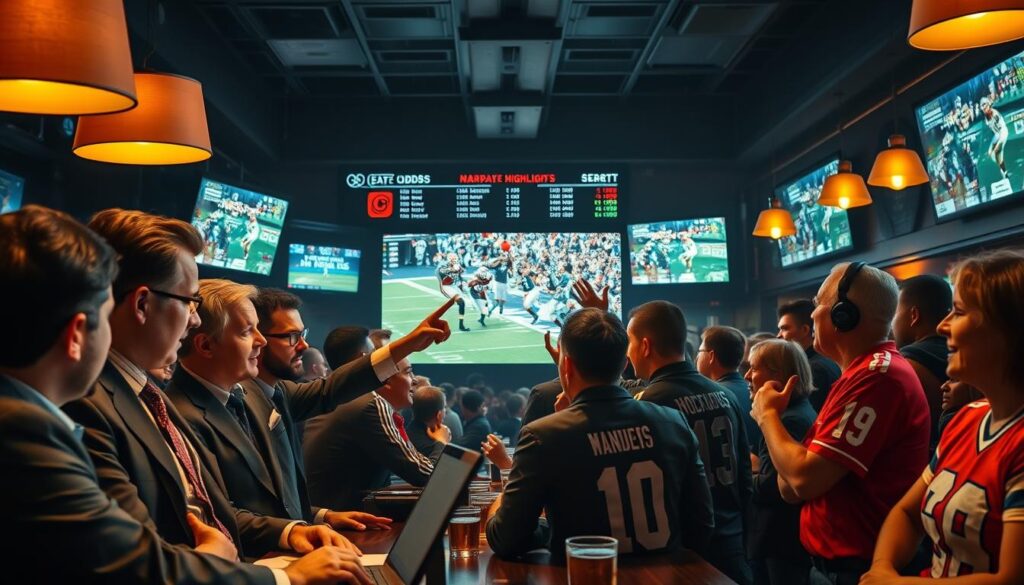
Finding these overreactions needs a careful plan. You’re not just looking for a lot of bets. You’re finding the specific story that’s causing the imbalance. Is it media frenzy, rivalry emotions, or TV hype?
| Overreaction Trigger | Public Behavior | Typical Line Impact | Contrarian Signal |
|---|---|---|---|
| Media Hype Cycle | Chases “hot” teams, star players returning from injury, or “revenge game” narratives. Forms a strong consensus pick. | Line moves 1-2 points beyond where sharp models value the team, favoring the popular side. | When the dominant media narrative contradicts key, under-reported stats (e.g., poor defensive metrics for a “hot” team). |
| Rivalry Game | Overvalues home-field emotion and “want-it-more” factor. Bets heavily on the favorite or the public’s preferred rival. | Adds an extra 0.5 to 1 point to the favorite, often inflating a already reasonable line. | Historical data shows the underdog covers a high percentage in the rivalry, or the total points trend is ignored. |
| Marquee TV Window | Late, uninformed money pours in on the more recognizable team or the side with the simpler narrative. | Significant late line movement (1.5+ points) in the hours before kickoff toward the TV darling. | The opening line was stable for days, then gets pushed solely by pre-game hype and prime-time betting volume. |
| Returning Star Narrative | Assumes a single player’s return automatically returns the team to peak form, ignoring systemic issues. | Over-adjusts the line, making the team a touchdown favorite when they should be -4. | The player is coming off a major injury, is on a snap count, or the team’s problems were never solely about their absence. |
Remember, not every favorite is a bad bet. The narrative bias offers a chance, not a sure thing. Sometimes, the story is true, and the public is right. Your edge is in knowing when a line move is justified or an overreaction.
So, when the Chiefs’ line jumps on Sunday Night Football, or the Cowboys in a rivalry game, think twice. Is the team really 4 points better, or is it just an emotional tax? That’s where you find the edge.
Filters that matter: line movement with lopsided tickets, thresholds to act
Looking at a screen full of ticket percentages is like watching static. You need a tuner to find the signal. Without filters, raw data is just noise, like betting on a coin flip.
The first filter is obvious: the lopsided ticket. If one team gets 65%, 70%, or 80% of the bets, that’s a red flag. The market is too sure of one outcome, making the other side more valuable.
But, a crowded bandwagon isn’t enough. Line movement tells the real story. If the line doesn’t move with the heavy bets, or moves against them, the sportsbook is sending a message. Sharp money is betting against the public’s consensus picks.
The third filter is the final whisper. Look for a 10%+ gap between ticket and handle splits. If 70% of tickets are on Team A but only 60% of money is, Team B is the smart bet. This shows real disagreement, not just fan sentiment.
Think of these filters as a betting triage system. They help you quickly find games with real edges. Here’s how to use them:
- Step 1: Identify the Lopsided Ticket. Look for any side with 65% or more of the bets.
- Step 2: Interrogate the Line Movement. Did the line stay the same or move against the popular side?
- Step 3: Confirm with the Sharp Discrepancy. A 10%+ gap in ticket vs handle splits shows sharp money against the public consensus picks.
- Step 4: Act. Only act when all three filters match for a high-probability contrarian play.
This system turns complex data into a simple decision tree. It filters out games where the public might be right. For a real example, check out NFL Week 16 line moves. You’ll see where lopsided tickets met resistant lines, showing sharp contrarian plays. Without these filters, you’re just guessing. With them, you’re decoding the market.
Risk: fake splits, stale screens, books shading popular sides
The three biggest risks in betting aren’t bad luck or bad beats. They are fabrication, expiration, and manipulation.
Your edge depends on finding where the crowd is wrong. But what if the crowd is just a mirage or outdated? Let’s look at the three main problems.
First, there’s fake splits, or head-fake steam. It’s like financial performance art. A sharp, called The Puppeteer, bets on Team A at +6. The line then moves to +5.5.
The public sees this and bets on Team A, thinking they’re following smart money. The Puppeteer then bets big on Team B at +5.5. He made the crowd think Team A was the smart choice. You bet on the wrong side, and it hurts.
Second, there’s stale data. Using old bet splits is like making weather decisions based on yesterday’s sunburn. The “public” percentage you see might be outdated.
Money moves fast. A rumor, a lineup change, or sharp money can change the consensus in minutes. If your data isn’t current, you’re betting against a ghost.
Third, there’s book shading. Sportsbooks are not just passive. They’re smart and want to make money. They know the Dallas Cowboys attract more bets.
So, they might make the Cowboys’ spread higher, not because of sharp money, but because of public demand. Oh, what a generous bookmaker! Your smart bet just got harder to win.
This isn’t a conspiracy; it’s just business. Popular sides often have a hidden tax. Ignoring this is like not knowing P.T. Barnum raised ticket prices for the main attraction.
| Risk Type | How It Works | The Contrarian Trap | How to Spot It |
|---|---|---|---|
| Fake Splits | A sharp bets Side A to move the line, enticing public money onto A, then bets bigger on Side B. | You follow the “smart” line movement, betting with the fabricated consensus against the real sharp money. | Line moves early, then sharply reverses. Large, isolated bets not followed by sustained pressure. |
| Stale Data | The bet split percentage you see is from hours ago and doesn’t reflect current, live wagering. | You base your fade on outdated information, missing a fundamental shift in betting patterns. | Source isn’t timestamped or explicitly “live.” Compare multiple real-time feeds if possible. |
| Book Shading | Books proactively move a line toward a popular side, anticipating public demand, not sharp action. | You get a worse price on your fade, eroding your value, because the book baked in the public’s bias. | Line moves against a key number (e.g., -7 to -7.5) very early, before significant betting volume is reported. |
See the problem? A simple contrarian strategy can fail because of these three issues. You need to check if the public is real, current, and if the book has already charged you a fee. Being cynical is key.
Building a contrarian checklist by sport and seasonality
The biggest mistake a contrarian bettor can make is treating every sport like it’s the same game. The NFL public is different from the March Madness crowd. College football Saturdays and NBA Tuesdays have their own vibes.
A one-size-fits-all approach to fade the public is a losing strategy. You need a seasonal playbook. Think of it as a dynamic checklist that evolves with the calendar.
Let’s build that playbook. We’ll start with the three major U.S. sports and their unique public psychology.
In the NFL, the narrative bias is king, under the lights. Primetime games feature marquee teams with built-in storylines. The public bets on the story, not the numbers. A contrarian looks for value against these emotionally charged narratives.
The NBA used to offer a golden trend: the bounce-back after a blowout. A team gets embarrassed one night? They’d cover next time out. It was statistical poetry. Until it wasn’t. The market caught on, and the edge evaporated. This is your perfect lesson: trends regress, and oddsmakers adjust.
College football presents a different puzzle. Low-total games—think 45 points or less—have historically been a haven for underdog covers. Why? Fewer scoring opportunities mean more variance. A single turnover or special teams play swings everything. The public undervalues this chaos.
See the difference? Each sport demands its own filters. Your checklist must reflect this. Below is a snapshot of how to apply surgical precision to each arena.
| Sport | Key Public Bias | Contrarian Filter | Seasonality Note | Market Evolution |
|---|---|---|---|---|
| NFL | Primetime narrative bias on national TV | Fade heavily bet favorites in standalone night games | Extreme in Week 1 (overreactions) and Super Bowl (casual flood) | Slow; narratives are persistent year-to-year |
| NBA | Overreaction to last game’s result (win/loss, ATS) | Seek teams off bad losses, but verify line movement confirms smart money | Grind of 82-game season creates repetitive emotional cycles | Fast; specific trends like “bounce-back” get priced out quickly |
| College Football | Overvaluing brand-name power in spread betting | Target low-total games (≤45 pts) for underdog value; embrace variance | Rivalry week creates peak public emotional investment | Moderate; low-total edges can persist for seasons |
| Summary Insight | Your goal isn’t to find a universal rule. It’s to identify the unique, exploitable psychological loop for each sport and season. The checklist must be dynamic, not static. | |||
Now, let’s talk seasonality. Week 1 of the NFL is a festival of overreaction. The Super Bowl is a tsunami of casual money. Your approach to fade the public must account for this.
The NBA’s 82-game marathon creates different opportunities than the single-elimination panic of March Madness. In the NBA grind, public attention wanes. In the NCAA tournament, it peaks irrationally.
Your checklist should have seasonal sub-routines. Early NFL season: look for line overcorrections based on tiny sample sizes. March Madness: target the public’s obsession with Cinderella stories against efficient, boring teams.
Remember the NBA bounce-back lesson. An edge discovered is an edge that will eventually decay. Your playbook must be a living document. You can’t just set it and forget it.
This sport-specific framework is about applying the contrarian mindset with precision. It turns a vague idea of “betting against the crowd” into a structured process for making smarter bets. Build your checklist. Test it. And most importantly, revise it. The market never sleeps, and neither should your analysis.
Bankroll and tilt control for drawdown stretches
Managing your bankroll is not just about numbers; it’s about mental strength. When your picks go wrong, it feels like everyone is laughing at you. This part is your guide to keeping your bankroll safe during tough times.
The Martingale system is a classic, but it’s risky. It tells you to double your bet after each loss, hoping to win big next time. But, you’ll hit the betting limit, which is financial disaster. The real lesson is not about a specific method; it’s about staying safe. No strategy guarantees wins all the time. Losing money to chase losses is a big mistake.

So, what’s the better choice? The flat-betting strategy is the unsung hero of betting. You bet the same amount every time, no matter how sure you are. It’s not about making a quick fortune. It’s about handling the ups and downs of betting.
Your bet size should be small enough not to hurt your wallet. A good rule is to risk 1% to 2% of your bankroll per bet. This keeps you playing for the long haul.
Tilt is a big problem in betting, borrowed from poker. It’s when you get angry and start making bad bets. Tilt control is like meditation for your betting account. Know when you’re betting out of anger, not logic. If you feel tilt, stop and come back later.
Building discipline helps you handle drawdowns better. It’s the difference between being controlled by your emotions and being a sharp, patient bettor. Your bankroll is your team. Don’t risk it all.
Case studies: headline games vs small‑market gems
Enough theory—let’s look at how contrarian bets play out. We’ll see the difference between big games and small ones. Both have their own charm, but only one gets all the attention.
Let’s hit the tape.
Case Study 1: The Sunday Night Spectacle. It’s Patriots vs. Cowboys. The hype is huge. On DraftKings, 78% of bets are on the Patriots -4. But the line stays the same.
At Circa Sportsbook, it’s different. About 65% of money is on the Cowboys. This shows a key difference between what people bet on and what they actually bet.
Case Study 2: The Tuesday Night MACtion Gem. Switch to Toledo at Ball State. The total is 44.5. But not many people are watching.
Sharp bettors, though, are paying attention. They know about a key Toledo player’s injury. This info is not well-known. They bet on the underdog, using this secret info.
The table below shows the big differences between these two betting scenes. They both use the same strategy but in different ways.
| Aspect | Headline Game (Patriots vs. Cowboys) | Small-Market Gem (Toledo vs. Ball State) |
|---|---|---|
| Game Profile | National TV, prime time, rivalry narrative | Weeknight, conference game, limited broadcast |
| Public Ticket % | Extremely lopsided (e.g., 78% on favorite) | Near even or lightly bet, showing public disinterest |
| Sharp Money Signal | Heavy reverse money flow on the opposite side | Concentrated, smart money on a specific angle (injury, line move) |
| Key Data Source | Split between public book (DraftKings) & sharp book (Circa) | Injury reports, line movement at sharp books, low-volume triggers |
| Typical Contrarian Move | Fade the overwhelming public consensus picks | Act on niche information before it becomes consensus |
The main lesson is about fighting different battles. In big games, you battle emotions. In small games, you battle being unknown.
Both need courage to fade the public. But the tools are different. Big games need tracking ticket vs. money percentages. Small games need digging for news. Missing out on either means missing half the chance. The bright lights show one truth. The shadows reveal another.
Conclusion
Forget the final score on the screen. The only number that matters is the one in your bankroll.
A winning contrarian betting strategy isn’t just saying no to the crowd. It’s about smart doubt. You now see the crowd’s excitement as something you can use. You can find hidden chances in split data and during rivalry weeks.
Source 1 shows us: betting with the smart money can lead to steady wins. Source 2 reminds us: there’s no easy way, just careful thinking and money handling.
Your main goal is to bet against the crowd when they’re most emotional. Do it with the calm of a chess player, not the passion of a fan.
This is a long-term game. The house wins because the public loses overall. Your task is to quietly leave the losing side. A true contrarian strategy means betting with the crowd’s mistakes.
So, use your checklist. Keep your emotions in check. Bet against the public with smart thinking. Let the masses follow the bright lights. Your win comes from steady, quiet effort.
Leave a Reply