

Prediction Market Regulation is becoming as relevant to sports bettors as the price on the screen. Global trading volume climbed sharply in the third quarter of 2026, while state lawmakers and courts challenged where sports event contracts could be offered. As of November 22, 2026, those trends tell different stories: one measures trading activity, and the other concerns who can offer which products and where. The signals worth watching are court orders that change access, federal bills that move beyond proposals, and evidence that individual sports markets have enough depth to make their displayed prices meaningful.
What the 2026 Trading Surge Measured
Global prediction market notional volume reached $189.7 billion in Q3 2026, up 65.6% from the previous quarter, according to CoinGecko’s Q3 industry report. September 2026 alone set a monthly record of $79.5 billion. That is a measure of the value represented by trading, not a count of unique users or an estimate of how much those users won or lost. It is also a global figure, not a measure of U.S. sports wagering. The increase shows how much more activity passed through prediction markets, but it does not establish how widely that activity was distributed.
Why Sports Demand Is Not the Same as Market Depth
Pew Research Center reported that combined monthly trade volume across Kalshi and Polymarket rose from roughly $26 billion in May 2026 to about $53 billion in July 2026, largely driven by sports-related contracts. That narrower measure helps explain why sportsbook customers have reason to follow the story. It covers two platforms and a different period from the global quarterly figure, so the numbers should not be added or used to calculate a U.S. market share. The increase also says nothing about how much was available at a given price on an individual matchup.
Polymarket’s geographic split offered another signal. Polymarket US launched under Commodity Futures Trading Commission oversight in late 2025 and accounted for roughly 4% of total Polymarket trading volume in January 2026 and 39% in July 2026. The denominator was Polymarket’s own trading volume, not all U.S. prediction market activity. The shift showed that the U.S. product accounted for a larger share of that platform’s trading in July. It did not show whether any particular sports contract was available in a given state.
Prediction Market Regulation and State Access
Six states passed laws concerning prediction markets in 2026, while another 16 introduced bills, according to the Nebraska Legislature’s research snapshot. Those categories signal different stages of state action. An introduced bill does not change access by itself, and even an enacted law can raise separate questions about effective dates and enforcement. The count shows how broadly lawmakers took up the issue, but it does not tell readers which contracts they could access in any of those states on November 22, 2026.
Minnesota passed a law in May 2026 that was set to ban prediction markets as of August 1, 2026. Kalshi, Polymarket and the CFTC sued to block enforcement. In Michigan, an Ingham County court barred Kalshi from offering sports event contracts to users in the state on June 29, 2026, pending resolution of a lawsuit. The actions were different: Minnesota’s dispute followed a law, while the Michigan order targeted sports contracts from a named operator. Neither account establishes the latest enforceable position as of November 22, 2026.
The central dispute is whether federal oversight displaces state gambling law for the contracts at issue. A ruling that settles that question could have wider consequences than an order that temporarily pauses enforcement or applies only to a single platform. That distinction matters when reading an appellate decision or assessing what a potential Supreme Court ruling might resolve. The first question is what the court actually decided; the second is which operators, products and jurisdictions the decision covers. Related coverage of state authority and industry pushback gives context for why those questions recur.
Federal Bills and Consumer Protections
Prediction Market Regulation in Congress
The federal proposals addressed several distinct questions: which contracts exchanges could list, what authority regulators would have, and what protections users would receive. S. 4060 set out proposed minimum standards, while S. 4469 focused on CFTC oversight and H.R. 8148 addressed how parts of the Commodity Exchange Act would apply. Those proposals should not be read as a single package. Nor do the bill descriptions establish that any of these provisions had taken effect by November 22, 2026.
| Federal Bill | Proposed Focus |
|---|---|
| S. 4060: Prediction Markets Security and Integrity Act of 2026 | Minimum standards covering age limits, advertising, national self-exclusion and restrictions on contracts tied to war, death or military action. |
| S. 4469: Prediction Market Act of 2026 | Enhanced CFTC oversight. |
| H.R. 8148: RISK Act | Application of certain Commodity Exchange Act provisions to prediction market contracts. |
For a sports customer, a self-exclusion proposal raises a practical question: would an exclusion initiated with one operator also apply elsewhere? A national mechanism would matter most if its scope and implementation matched what users reasonably expected. The same distinction applies to advertising and age restrictions, where a proposal is not proof of a platform’s existing policy. The research identified those protections as matters under consideration, not as uniform safeguards available to every user.
Prediction Market Regulation also turns on how lawmakers define restricted contracts. Proposals addressing war, military action or death raise questions about where the category begins and how exchanges would apply the language. A public-interest test raises a separate question about how a regulator would decide which contracts qualify. Even if a bill clarified both points, that would not necessarily answer whether state gambling rules still apply to a contract on a sports result. The scope of permitted contracts and the division of authority are separate tests.
How Sports Contracts Compare With Sportsbook Prices
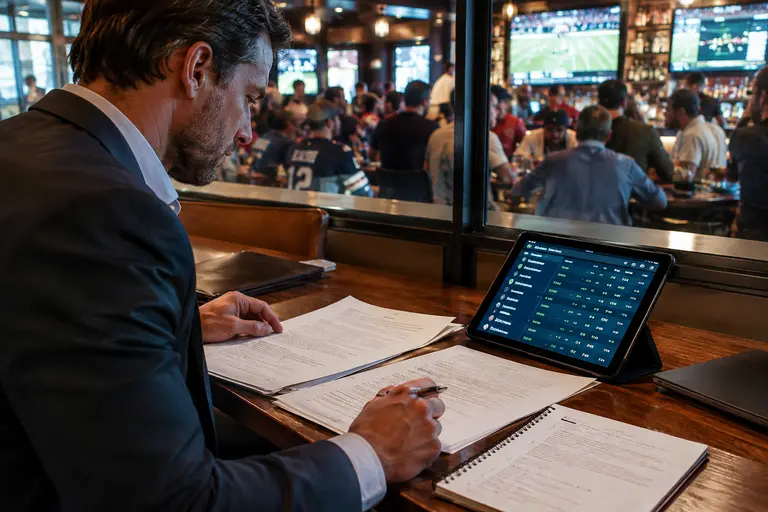
Consider two products on the same professional matchup: an exchange contract tied to a team winning and a sportsbook moneyline on that team. The labels may look equivalent, but the comparison starts with settlement, not price. Do both products count overtime, and what happens if the game is postponed? If those rules differ, the products need not pay out in the same circumstances. An apparently better price may reflect a different proposition rather than better terms on the same outcome.
Once the rules match, the useful comparison is between prices actually available at the same time. On the exchange side, the most recent trade does not tell a reader how much is offered at that price or how wide the gap is between buyers and sellers. On the sportsbook side, the relevant figure is the operator’s available price, not an older screenshot. Fees can change the comparison, and prices can move before kickoff. Those differences are more informative for a particular matchup than either platform’s total monthly volume.
Timing gets more demanding during live play. After a scoring change, two screens checked moments apart may reflect different game states, and the displayed price may no longer be available. For a player prop, the comparison also depends on whether both products use the same statistic and the same settlement rules. A broader menu is not evidence of deeper trading in any one market. Betting Challengers is a related site in the same network; it highlights how the terms of any specific product are determined by the operator.
What Would Change the Outlook for Sports Event Contracts
The first signal is an enforceable change in access. Prediction Market Regulation can generate several headlines around one dispute, but a filing, a temporary order and a decision on federal preemption do not do the same work. The Michigan order on June 29, 2026, and Minnesota’s August 1, 2026, effective date illustrate why those distinctions matter. Readers assessing a change need the latest order or rule and the operator’s eligibility terms, not an inference from national volume or from an app listing.
The second signal is a protection that users can verify. A bill moving forward matters differently from an age check, an advertising restriction or a self-exclusion process that is actually in effect. The useful questions are concrete: which products and operators are covered, what happens after a user self-excludes, and where can a customer dispute a settlement? Those answers allow a fairer comparison with a regulated sportsbook than treating federal oversight and state licensing as interchangeable labels.
The third signal is consistent depth in the sports markets readers actually follow. The $79.5 billion recorded globally in September 2026 showed substantial trading activity, but it did not show whether a specific pregame or live market could support its displayed price. A close comparison still depends on access, matching settlement terms, available prices and fees. If those details cannot be verified, there is no sound basis for treating one format as better. Popularity is a reason to pay attention, not evidence of better terms or more predictable outcomes.