

Bet Cost Analysis is a practical way to read the true cost of a bet without assuming that a lower headline price is automatically better. For bettors comparing prediction markets with regulated U.S. sportsbooks, the question is not just who posts the attractive number. It is how much is paid through vig, fees, bid-ask spread, liquidity limits, and product rules before the event settles.
The comparison became sharper during 2026 because prediction markets and sportsbooks were pricing many sports outcomes in different formats. Sportsbooks showed odds that included operator margin. Prediction markets showed contract prices that looked closer to direct probabilities, but those prices still carried trading costs. A careful reader should treat both as uncertain markets, not as paths to assured returns.
Bet Cost Analysis Starts With The Full Price
The true cost of a bet is the gap between the displayed opportunity and the fair value a bettor would need to break even over many similar decisions. With a sportsbook, that cost is often discussed as vig or hold. In simple two-outcome markets, the sportsbook can shade both sides so the implied probabilities add up to more than 100 percent. That excess is part of the operator’s margin.
Prediction markets express outcomes differently. A contract priced at 60 cents can roughly read as a 60 percent market expectation before fees and spread. That format is clear, but it is not free. A trader may pay taker fees, face a bid-ask spread, or struggle to enter and exit at the displayed price if the market is thin.
Bet Cost Analysis For One-Hour Prices
The clearest data point in the supplied research came from games played between August 29 and October 18, 2026. One hour before start, backing both sides cost about $0.039 per dollar on Kalshi, $0.033 per dollar on Polymarket US, and about $0.041 to $0.044 per dollar using median sportsbooks, according to true-cost research. That sample suggested that prediction markets often had a lower all-in cost at that point in time, but it did not make every contract cheaper or every trade better.
| Channel | Cost Component | Practical Reading |
|---|---|---|
| Regulated sportsbook | Vig or hold built into odds | The price is simple to read, but margin is usually embedded. |
| Prediction market | Contract price, fees, and spread | The probability may be clearer, but execution cost still matters. |
| Line shopping across sportsbooks | Different operators post different prices | Cost may fall if a bettor can access more favorable legal prices. |
| Thin exchange market | Wider spread and lower depth | The displayed price may be hard to trade in size. |
For Bet Cost Analysis, the key lesson is that timing matters. A market one hour before a game may be more liquid than the same market days earlier. A line near kickoff may reflect fresher public information, while still including fees, margin, and limits.
Prediction Markets Show Prices, Fees, And Spread
Prediction markets can appeal to price-sensitive bettors because contract prices look like probabilities. That can make comparison easier than converting American odds across several sportsbook apps. Still, a displayed probability is only the start. The actual cost depends on the contract terms, the taker fee, the bid-ask spread, and whether there is enough depth at the price shown.
The supplied research also pointed to strong calibration in many prediction markets. By one day before resolution, strong favorites priced close to 90 cents won about 98.0 percent of the time on Polymarket, while favorites across all markets won about 76.9 percent one day out, based on a prediction-market accuracy study. In the less certain 10 to 90 percent probability range, favorites won about 65.9 percent of the time.
Calibration Is Not The Same As Profit
Calibration means prices may contain useful information. It does not mean a bettor receives a favorable trade after costs. A 60-cent contract that wins at the right long-run rate can still be unattractive if fees and spread erase the gap. This is where prediction-market clarity can be both helpful and misleading: the probability may be visible, while the all-in trading cost sits one layer deeper.
The research notes also described concerns around smaller liquidity and reduced returns from fees among prediction-market users. Those concerns fit the product structure. A liquid market can let users enter and exit close to the visible price. A thin market can make the next available price meaningfully worse, especially for users who are late, impatient, or trading niche outcomes.
Regulated Sportsbooks Build Cost Into Odds
Regulated sportsbooks usually present the more familiar product. Bettors see moneylines, spreads, totals, player props, and live markets. The ticket is easy to understand, but the price has operator margin inside it. The bettor does not receive a separate invoice for vig. The cost is in the odds.
In the research notes, state-licensed U.S. sportsbooks in an October 2026 snapshot of 20 NFL and NBA games showed average margins from about 4.08 percent at the low end to about 4.90 percent at the high end. The same notes said taking the more favorable price across sportsbooks on both sides could reduce that margin to about 2.26 percent. That is not a betting recommendation. It simply shows why price comparison can change the cost of the same opinion.
Vig Can Be Stable Across Main Markets
Another research point found sportsbook margin clustered in a fairly narrow range across several sport types, with higher margin in boxing. Separate 2026 data in the notes said two-outcome head-to-head markets averaged about 4.8 percent bookmaker margin, while player-prop markets averaged about 7.6 percent. The type of bet can matter as much as the sport. A main-market moneyline may be cheaper than a prop with less liquidity and more operator protection.
That distinction matters for readers comparing sportsbooks with exchanges. Prediction markets may not always offer the same prop depth, same-game features, or live menu. Sportsbooks may carry higher embedded margin in some markets, but they also offer broader consumer-facing products in regulated states.
Access, Liquidity, And Product Fit Change The Cost
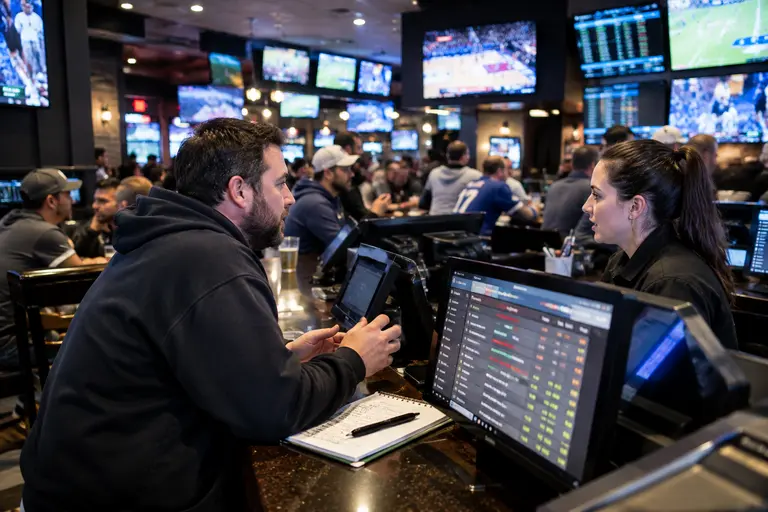
Cost is not only arithmetic. Access rules, settlement terms, and product design can change the practical value of a price. The research notes described U.S. prediction markets as federally regulated, while sportsbooks are regulated through state sports betting systems. That distinction affected availability and product treatment during 2026, but readers should check lawful access and platform rules in their own jurisdiction rather than assuming one model is interchangeable with the other.
Access Is Part Of The User Cost
If a bettor cannot legally access an operator, that operator’s price is not useful. If a market has unclear settlement language, the displayed price may carry dispute risk. If a live market moves too quickly or an app limits available stake size, the quoted number may not be the number a user actually receives. These are not dramatic costs, but they affect real decisions.
For a detailed look at how these components interact, readers are encouraged to explore Sharp-9 market coverage for related context.
- Read the all-in price, not only the headline number.
- Separate probability information from expected return after costs.
- Check whether liquidity supports entry and exit near the displayed price.
- Compare regulated sportsbook prices where lawful access is available.
- Treat props and niche markets as potentially more expensive than main markets.
What Bet Cost Analysis Means For Bettors
Bet Cost Analysis should make bettors slower, not bolder. The 2026 research suggested that liquid prediction markets sometimes carried lower costs than median sportsbook prices near start time. It also showed why that claim needs limits. Fees, spread, lower depth, and category-specific bias can all change the final result.
Regulated sportsbooks remain easier for many users to understand, especially for standard sports betting formats. Prediction markets may offer clearer probability signals and, in some samples, lower visible cost. Neither side removes uncertainty. A careful comparison asks what the bet costs, how the market settles, whether the displayed price can actually be traded, and whether the product fits the user’s legal access and risk tolerance.