

Binance has begun restoring cryptocurrency withdrawals following a major security breach that exposed approximately $6.3 billion in digital assets, but the reopening process is gradual rather than immediate across every supported blockchain network.
Beyond official exchange announcements, cryptocurrency users can benefit from discussing payment experiences with other sports bettors. A sports betting forum can provide community discussions about cryptocurrency deposits, withdrawal delays, sportsbook payment policies, and account verification procedures. While individual experiences should not replace official information from Binance or a sportsbook, comparing user reports can help bettors identify recurring payment concerns and understand which questions to ask before transferring funds.
The cryptocurrency exchange announced on November 1, 2026, that its first phase of withdrawals would begin between 06:00 and 09:00 UTC. Bitcoin, Ethereum, BNB, Solana, XRP, and several stablecoin networks were included in the initial recovery plan, although individual asset-network combinations would become available progressively.
For sports bettors who use cryptocurrency to fund betting accounts, the announcement raises an important question: Does the restoration of Binance withdrawals mean crypto transfers to sportsbooks are operating normally again?
Not necessarily.
A sportsbook may accept Bitcoin or USDT, but a successful transfer also depends on whether Binance has reopened the corresponding withdrawal network, whether the receiving platform supports that network, and whether additional security checks affect transaction processing.
According to Binance’s November 1 withdrawal recovery announcement, the company had replenished approximately 95% of the assets affected by the breach. It also committed to absorbing the financial impact rather than passing the losses to users.
The recovery is an important development for the cryptocurrency market. For bettors, however, the more immediate issue is understanding which transfers are available, how to verify payment instructions, and why moving funds during a security recovery requires additional attention.
What Happened During the October 29 Binance Security Breach?
Binance disclosed that unauthorized withdrawals began after its hot-wallet infrastructure was compromised at approximately 20:05 UTC on October 29, 2026.
Hot wallets are cryptocurrency storage systems connected to online services. Exchanges use them to facilitate withdrawals and other transactions that require readily accessible digital assets.
Unlike offline cold storage, hot-wallet infrastructure must interact with active systems, making operational security particularly important.
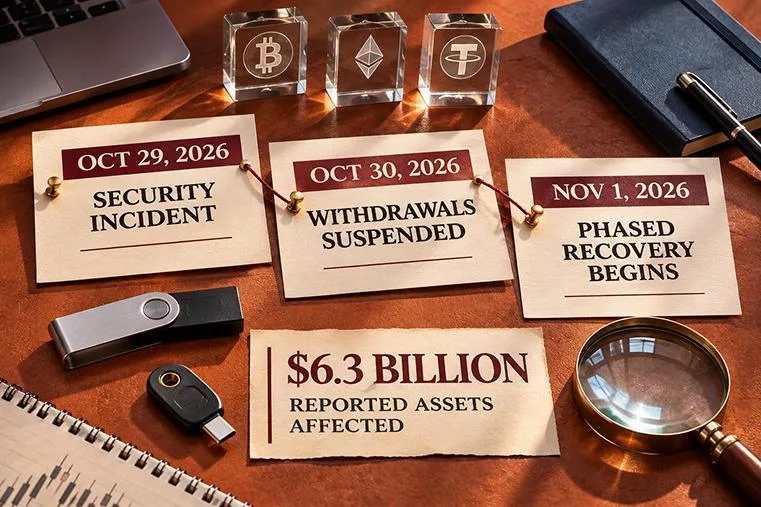
In its October 30 incident report, Binance estimated that approximately $6.3 billion in cryptocurrency assets had been stolen. The affected assets included Bitcoin, Ethereum, BNB, USDT, and USDC.
The exchange initially suggested that a compromised employee laptop may have contributed to the incident. However, subsequent investigations identified additional potential points of compromise.
Binance stated that investigators had not found evidence of leaked wallet private keys, while emphasizing that the investigation remained ongoing.
The company responded by suspending withdrawals, revoking affected authorizations, strengthening security controls, and coordinating with blockchain intelligence firms and law enforcement.
By October 30, Binance reported that approximately $3 billion in affected assets had been frozen on-chain.
Its October 30 security incident update also explained that deposits and unaffected platform services remained operational during the withdrawal suspension. Binance Support
That distinction matters because the incident did not necessarily prevent cryptocurrency from arriving at Binance. Instead, the principal restriction involved customers’ ability to move assets out of the exchange while security checks were completed.
For someone holding cryptocurrency intended for a sports betting account, this could mean that funds remained visible in the exchange account but could not immediately be transferred to an external wallet.
Binance Begins Restoring Withdrawals on November 1, 2026
Binance’s recovery announcement established a phased approach to restoring withdrawals.
Rather than reopening every supported cryptocurrency and blockchain simultaneously, the exchange prioritized specific combinations of assets and networks based on recent customer demand.
The first phase was scheduled to begin on November 1 between 06:00 and 09:00 UTC.
Binance explained that the process would involve additional stability and security checks before individual withdrawal routes became available.
This means that seeing Bitcoin or USDT on the initial recovery list did not guarantee that every customer could immediately complete a withdrawal using that asset.
Some networks could become available before others. Temporary delays could also occur because of increased transaction demand during the reopening period.
The company advised customers to consult its official withdrawal interface or network status information before attempting transfers.
Which Cryptocurrencies Were Included in the First Withdrawal Phase?
The initial recovery announcement identified several cryptocurrency networks commonly used for transfers between exchanges, personal wallets, and online services.
| Blockchain Network | Assets Included in Initial Recovery |
|---|---|
| Bitcoin | BTC |
| Ethereum | ETH, USDT, USDC |
| BNB Smart Chain | BNB, USDT, USDC |
| TRON | TRX, USDT |
| Solana | SOL, USDT, USDC |
| XRP Ledger | XRP |
| Polygon | POL, USDT, USDC |
| Arbitrum | ETH, USDT, USDC |
| Base | ETH, USDC |
| Optimism | ETH, USDT, USDC |
Other networks listed by Binance included Zcash, Dogecoin, TON, Avalanche C-Chain, and Sui.
The list identifies the asset-network combinations included in the planned first phase, not a guarantee that every combination was fully operational at a particular moment.
This distinction is especially important for stablecoins.
USDT transferred through Ethereum is not operationally interchangeable with USDT transferred through TRON or BNB Smart Chain when a receiving platform supports only one of those networks.
A customer must verify both the cryptocurrency and the blockchain network before initiating a transfer.
Why Binance’s Withdrawal Recovery Matters for Crypto Sports Betting
Cryptocurrency has become a payment option at some online sportsbooks, particularly platforms serving international markets.
Bitcoin and stablecoins can provide alternatives to traditional bank transfers, although availability, processing rules, and consumer protections vary significantly between operators and jurisdictions.
For bettors who acquire cryptocurrency through Binance, the exchange can function as an intermediate step between traditional funds and a sportsbook account.
A typical transaction may involve purchasing cryptocurrency on an exchange, withdrawing it to a personal wallet, and transferring it to a receiving platform.
However, some services prohibit direct transfers involving gambling-related addresses or certain jurisdictions.
This creates an additional layer of risk when an exchange experiences a security incident.
Even if a sportsbook’s cryptocurrency deposit system is functioning normally, customers may be unable to fund their accounts when the exchange they use has suspended outgoing transfers.
The reverse situation can also occur.
A sportsbook may process a cryptocurrency withdrawal successfully, but a receiving exchange might impose additional deposit reviews, compliance checks, or account restrictions.
There is no verified evidence in Binance’s incident announcements that the October 29 breach directly compromised sportsbook wallets or sportsbook customer accounts.
The relevant connection is operational: cryptocurrency betting payments can depend on exchange availability, network compatibility, and payment processing systems outside the sportsbook’s control.
For bettors, understanding those dependencies is more useful than assuming every cryptocurrency payment disruption originates with the betting operator.
What Crypto Bettors Should Verify Before Transferring Funds
The return of withdrawals does not eliminate the need for ordinary payment verification.
During a phased recovery, checking the details of a transaction becomes particularly important because the exchange may support one cryptocurrency on several networks while the receiving sportsbook accepts only a subset of them.
Before transferring funds, bettors should review the following:
- Withdrawal availability: Confirm that Binance currently permits withdrawals of the selected asset on the intended network.
- Receiving address and network: Verify the destination address directly through the sportsbook’s official cashier and confirm that both platforms support the same blockchain.
- Minimum deposits and fees: Check the sportsbook’s minimum accepted deposit, Binance’s withdrawal fee, and any applicable network costs.
- Account restrictions: Confirm that the transaction is permitted under the exchange’s terms, the sportsbook’s rules, and applicable local laws.
- Processing and verification: Check whether the receiving platform requires blockchain confirmations, identity verification, or additional payment reviews.
- Transaction records: Retain the transaction hash, withdrawal confirmation, and any relevant customer-support correspondence.
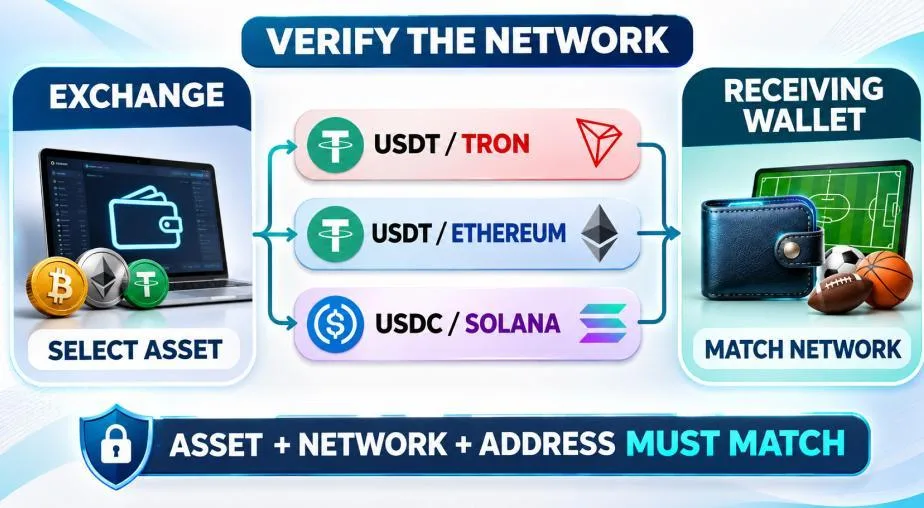
A transfer should not be initiated simply because a network appears in Binance’s recovery announcement.
The actual withdrawal interface must show that the asset-network combination is available.
Likewise, a sportsbook displaying a Bitcoin deposit address does not establish that it accepts wrapped Bitcoin or other Bitcoin-related tokens issued on different networks.
These details are especially important because blockchain transfers generally cannot be reversed once confirmed.
Readers evaluating cryptocurrency-friendly betting platforms can also consult our guide to researching offshore sportsbook reputation, which examines payout records, banking policies, and customer-support transparency before depositing funds.
Why USDT and USDC Network Selection Matters More Than the Token Name
Stablecoins introduce a complication that can be easy to overlook.
A token such as USDT can exist on multiple blockchain networks, but receiving platforms do not necessarily support every version.
For example, Binance’s November 1 recovery plan included USDT withdrawals through Ethereum, BNB Smart Chain, TRON, Solana, Polygon, Arbitrum, and Optimism.
A sportsbook might accept USDT on TRON while declining USDT on Ethereum.
Both transfers involve the same stablecoin brand, but the underlying blockchain infrastructure is different.
Sending funds through an unsupported network can result in a failed credit, lengthy recovery procedures, or permanent loss.
The same issue applies to USDC, which Binance listed on Ethereum, BNB Smart Chain, Solana, Polygon, Avalanche C-Chain, Arbitrum, Base, and Optimism.
The appropriate network is determined by the receiving service’s deposit instructions, not simply by whichever option appears cheapest or fastest.
Transaction fees and confirmation times can vary, but those considerations are secondary to compatibility.
A low-fee transaction provides no advantage if the receiving platform cannot recognize or credit it.
During the recovery period, Binance has also warned that elevated traffic may cause delays. Customers should distinguish between an exchange processing delay, a blockchain confirmation delay, and a sportsbook’s internal account-crediting process.
Each occurs at a different stage of the transaction.
Binance Reports 95% Asset Replenishment and New Proof of Reserves Verification
Beyond restoring withdrawals, Binance has been rebuilding the assets affected by the breach.
On November 1, the company reported that approximately 95% of the impacted assets had been replenished through company resources and market purchases.
It stated that the remaining 5% involved less-liquid tokens requiring additional time to source.
Binance also said that balances in ten major assets, including BTC, ETH, USDT, USDC, BNB, SOL, and XRP, were fully backed.
On November 2, the company published another security recovery update, announcing that the zero-knowledge proof associated with its October 31 Proof of Reserves snapshot was available for independent user verification.
The snapshot was taken at 00:00 UTC on October 31, and Binance said another snapshot covering additional assets was planned for November 4. Binance Support
Proof of Reserves allows users to verify that specified assets are represented in a published reserves snapshot.
However, it should not be confused with an unconditional guarantee against future security incidents, operational disruptions, or every possible financial liability.
It is also important to distinguish asset replenishment from stolen-fund recovery.
When an exchange uses its own money to replace missing cryptocurrency, it can restore backing without necessarily recovering the original stolen assets.
For cryptocurrency bettors, the practical implication is that the exchange has made progress toward restoring normal operations, but the recovery process remains incomplete.
How Withdrawal Delays Can Affect Sports Betting Decisions
Cryptocurrency payment interruptions can create timing problems for bettors who expect funds to be available before a particular sporting event.
Consider a hypothetical NFL game scheduled for Sunday afternoon.

A customer might intend to transfer cryptocurrency from an exchange to a sportsbook shortly before kickoff. If the exchange withdrawal remains unavailable, the bettor cannot assume that the deposit will arrive before the game begins.
Even when the transfer is eventually completed, the betting market may have changed.
A point spread, moneyline, or player prop available earlier in the day may no longer be offered at the same price.
The result is not a direct effect of the Binance hack on sportsbook odds. Rather, the payment delay can change when a bettor gains access to the market.
That distinction matters because transaction timing and betting value are separate issues.
A delayed deposit does not justify accepting a worse price, increasing a wager, or placing an unplanned bet.
The same principle applies to live betting, where odds can move quickly in response to scoring, injuries, possession changes, and other game developments.
A bettor who misses an intended market because of a payment interruption should evaluate the new price independently instead of assuming the original opportunity remains attractive.
U.S. Bettors Must Also Consider Exchange and Sportsbook Restrictions
The Binance recovery announcement concerns the global exchange’s affected services. It does not establish that every Binance-branded platform or cryptocurrency service is available to customers in the United States.
Binance.com and Binance.US are distinct services, and their supported products, jurisdictions, and withdrawal conditions may differ.
U.S. customers should verify which exchange entity holds their assets and consult that platform’s specific announcements rather than assuming the global Binance.com recovery schedule applies to them.
Sports betting laws create another distinction.
A cryptocurrency transfer does not make an otherwise unauthorized sportsbook legal. State-regulated sports wagering remains subject to licensing, age requirements, geographic restrictions, and payment rules.
In addition, exchanges and payment providers may prohibit transactions associated with certain gambling services.
Even where a sportsbook advertises cryptocurrency deposits, customers should verify whether their chosen exchange permits transfers to the relevant destination.
For readers comparing operators, the same research principles discussed in our offshore sportsbook reputation guide remain relevant: clear withdrawal terms, identifiable ownership, reliable support, and documented payout practices matter more than promotional claims.
What Happens Next in Binance’s Recovery?
Binance’s November 2 announcement confirmed that additional withdrawal networks and assets were scheduled for a subsequent recovery phase beginning November 3.
The exchange also planned to expand its Proof of Reserves coverage with a new snapshot on November 4.
Those dates represent announced recovery milestones rather than a guarantee that every withdrawal route will become available simultaneously.
Binance has said it intends to publish a technical post-incident report after completing its investigation.
That report may clarify the causes of the security breach, the effectiveness of the company’s containment measures, and the safeguards introduced afterward.
For cryptocurrency bettors, three developments deserve continued attention: the restoration of specific withdrawal networks, the availability of independent reserve verification, and any new restrictions affecting transfers to external platforms.
The central lesson of the incident is not that cryptocurrency betting payments have become universally unavailable or unsafe.
It is that access to digital assets can depend on multiple institutions and technical systems, even when a sportsbook itself remains operational.
As Binance continues its recovery, bettors should prioritize verified transaction information over assumptions about service availability. An exchange announcing that withdrawals have resumed is an important step, but a transfer should only be considered ready when the exact asset, blockchain network, receiving address, and applicable account rules have all been checked.